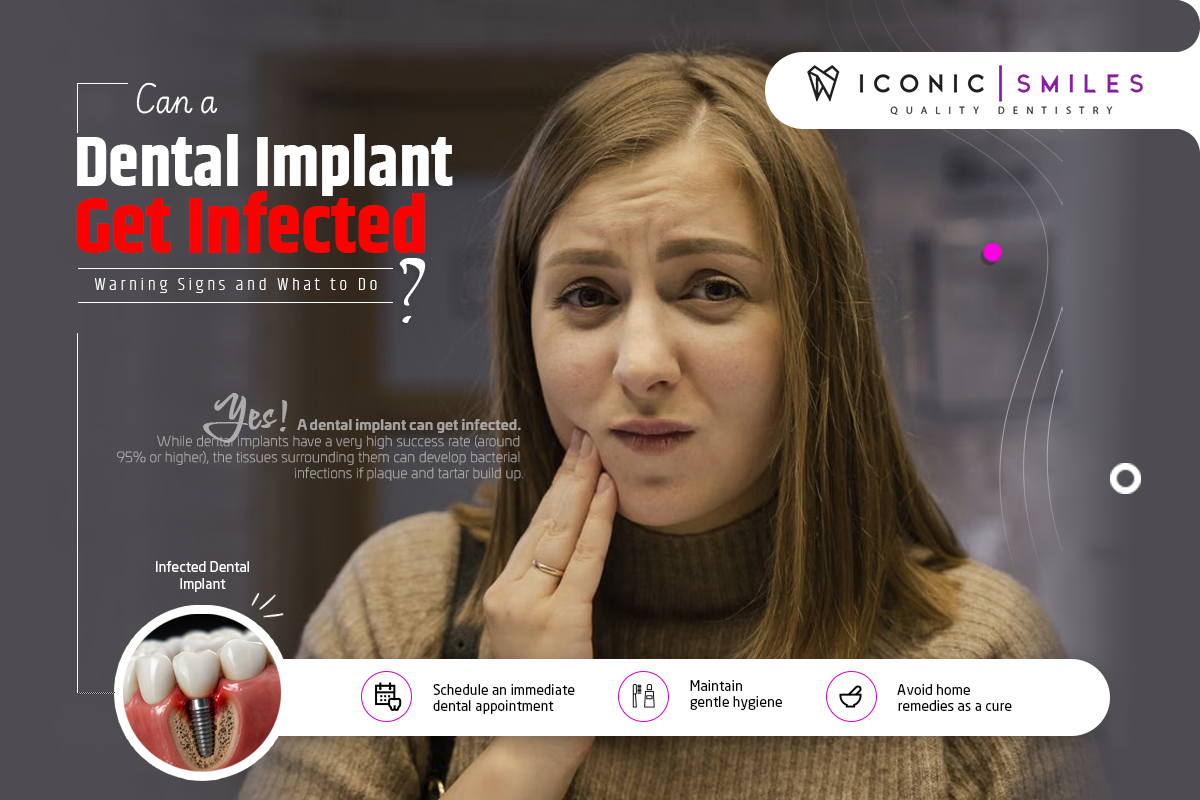
Yes. The tissues around a dental implant can become inflamed or infected. The implant itself cannot develop tooth decay, but plaque and bacteria can affect the surrounding gum and, in more advanced disease, the bone supporting the implant.
The important point is that an implant problem does not always hurt. Bleeding around the implant, swelling, pus, gum recession, a persistent bad taste or a change in the way the implant restoration feels can all justify assessment even when there is little pain. Early treatment is generally more straightforward than treating established bone loss.
Warning signs around a dental implant
| Warning sign | What it may mean | What to do |
| Bleeding around the implant | Peri-implant inflammation or plaque-related disease. | Arrange an implant assessment, particularly if this is new or persistent. |
| Red or swollen gum | Peri-implant mucositis or another local inflammatory problem. | Book a review and improve cleaning as advised. |
| Pus or persistent bad taste | Suppuration can indicate active peri-implant infection/inflammation. | Seek prompt dental assessment. |
| Gum recession or visible implant threads | Soft-tissue change and/or supporting bone loss may be present. | Arrange assessment and comparison with previous records/radiographs. |
| Crown feels loose or clicks | A screw, abutment or crown may be loose rather than the implant itself. | Avoid heavy chewing on it and contact your dentist. |
| The implant fixture itself moves | Possible loss of osseointegration or advanced loss of support. | Urgent dental assessment. |
| Increasing pain/swelling after implant surgery | Possible post-operative complication or infection. | Contact the implant team promptly. |
| Rapid facial swelling, fever/unwell, swallowing or breathing difficulty | Possible spreading infection. | Seek urgent dental/medical care; breathing difficulty is an emergency. |
What does “dental implant infection” actually mean?
Patients often use “implant infection” to describe several different problems. Clinically, it helps to separate them.
Infection or inflammation soon after implant surgery
In the days after implant placement, some soreness, bruising and swelling can be part of normal healing. Pain or swelling that is increasing rather than settling, discharge, fever or feeling systemically unwell should be reported to the implant team because these can indicate a post-operative complication.
Peri-implant mucositis
Peri-implant mucositis is inflammation in the soft tissue around an implant without progressive supporting bone loss. The gum may appear red or swollen and can bleed on gentle probing. It is the earlier and generally more manageable form of peri-implant disease, particularly when plaque control and professional care are addressed promptly.
Peri-implantitis
Peri-implantitis is more serious. It combines inflammation around the implant with progressive loss of the supporting bone. Bleeding or pus may be present, probing depths can increase and the gum may recede. Advanced disease can compromise the long-term stability of the implant and, in some cases, the implant may need to be removed.
Can peri-implantitis develop without pain?
Yes. This is one of the most important facts for implant patients. Peri-implant disease is often relatively symptom-free, especially until it becomes advanced or enters an acute phase. An implant can therefore feel comfortable while inflammation or bone loss is developing.
That is why implant maintenance matters even when everything feels normal. Bleeding on probing, changes in probing depth and radiographic bone levels can reveal disease that the patient cannot reliably detect at home.
Why is my dental implant loose?
A patient who says “my implant is loose” may actually have a loose crown, screw or abutment. These are mechanical complications and may be repairable while the implant fixture remains firmly integrated in bone.
True movement of the implant fixture itself is different and is more concerning. It can indicate failure of integration or significant loss of supporting bone and requires prompt assessment. Do not repeatedly test a loose implant with your tongue or fingers, and avoid heavy chewing on the area until it has been examined.
What increases the risk of peri-implant disease?
Peri-implant disease is usually not caused by a single factor. The risk is influenced by the health of the patient, the history of the mouth, the design and position of the restoration, and how effectively the implant can be cleaned and maintained.
Plaque accumulation and ineffective daily cleaning around the implant restoration.
A previous or current history of periodontitis (gum disease).
Smoking.
Poorly controlled diabetes or poor glycaemic control.
A restoration that makes the implant margins difficult to clean or monitor.
Retained cement or other local plaque-retentive factors in some implant restorations.
Irregular professional implant maintenance.
Parafunction such as heavy clenching or grinding can create mechanical loading problems, but it should not be described as causing bacteria to enter the gum.
How does a dentist diagnose an implant infection or peri-implantitis?
Diagnosis is more than looking for redness. A proper implant assessment may include checking plaque control and tissue appearance, gently probing around the implant for bleeding or pus, measuring probing depths and comparing them with previous records, checking the restoration for looseness or retained cement, assessing whether the restoration is cleanable, and taking an appropriate radiograph when indicated to compare supporting bone levels over time.
The distinction between peri-implant mucositis and peri-implantitis depends on whether progressive supporting bone loss is present.
Can an infected dental implant be saved?
Often, yes – but it depends on the diagnosis and how advanced the problem is. Peri-implant mucositis can often be controlled when plaque and local causes are addressed early. Peri-implantitis is more difficult because bone has already been lost.
Treatment may involve professional mechanical plaque removal, personalised cleaning instruction, correction of local plaque-retentive factors and review. More advanced peri-implantitis may require specialist or surgical management. Routine antibiotics are not a substitute for mechanical treatment and are not recommended as a routine treatment for peri-implantitis in primary care. Where progressive bone loss is severe or the implant is no longer maintainable, removal can be the safest option.
How can I reduce the risk of infection around a dental implant?
- Brush the implant restoration and gumline thoroughly twice a day.
- Clean between the implant and neighbouring teeth, or under implant bridges, every day using the method recommended for that restoration.
- Do not smoke; seek smoking-cessation support if required.
- Keep diabetes well controlled if you have it.
- Attend risk-based implant maintenance so that bleeding, probing changes and bone levels can be monitored over time.
- Report new bleeding, swelling, pus, recession, mobility or a change in the restoration rather than waiting for pain.
How Iconic Smiles assesses implant problems
At Iconic Smiles, implant aftercare is treated as part of the treatment rather than an optional extra. If an implant becomes sore, bleeds, feels different or is difficult to clean, we assess the soft tissues, probing measurements, restoration, bite and implant stability and compare radiographs where indicated. This helps distinguish a biological problem such as peri-implant disease from a mechanical problem such as a loose crown or screw.
If you are concerned about an implant, arrange an assessment with Iconic Smiles. We provide dental implant treatment and long-term implant maintenance across Hertfordshire and North London.
Frequently asked questions
Does a dental implant infection always hurt?
No. Peri-implant disease can develop with little or no pain, which is why bleeding, swelling, pus, recession and regular implant reviews matter.
Is bleeding around an implant normal?
Persistent bleeding around an established implant is not something to ignore. It can be a sign of peri-implant inflammation and should be assessed if it is new or recurrent.
Can antibiotics cure peri-implantitis?
Antibiotics alone do not remove the plaque, calculus, retained cement or other local factors driving the disease. Current UK guidance does not recommend routine local or systemic antibiotics for peri-implantitis in primary care.
Can a loose implant crown be repaired?
Often, yes. If the crown, screw or abutment is the moving component and the implant fixture is stable, the problem may be mechanical and repairable. It still needs prompt assessment.