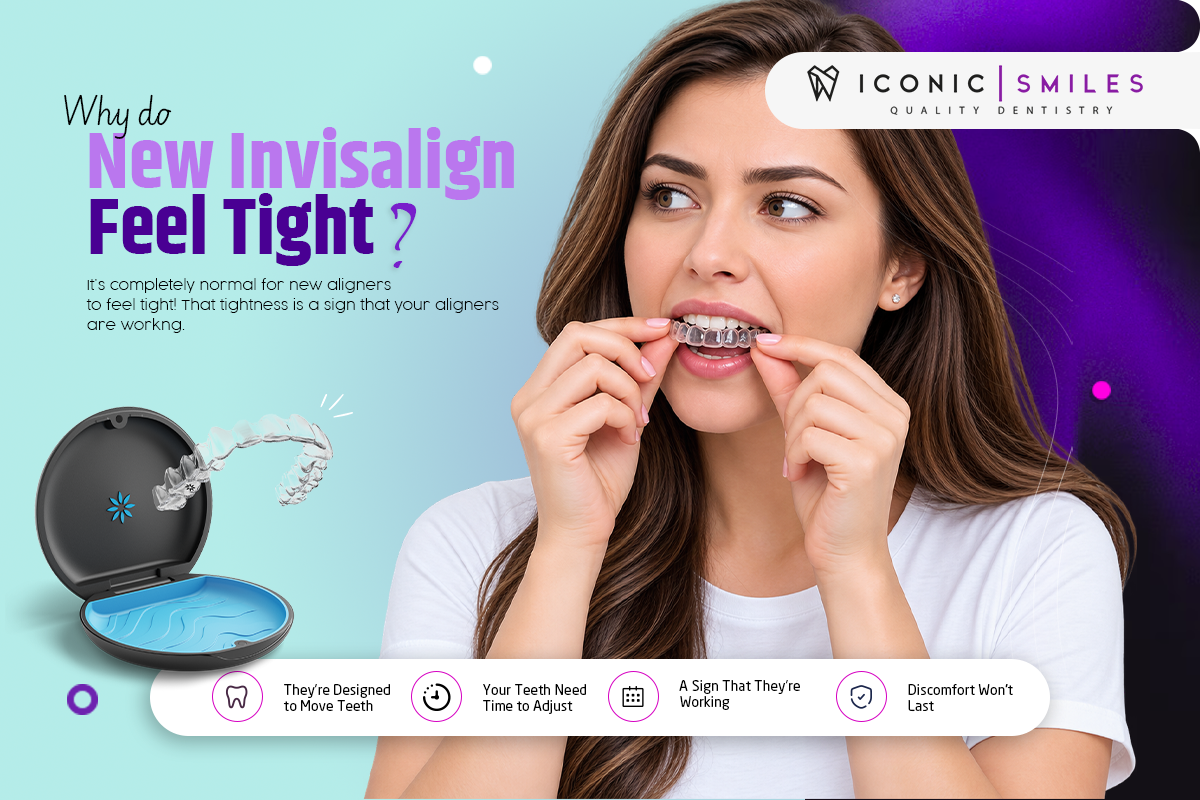
New Invisalign aligners are supposed to feel snug. Each aligner is made for the next planned stage of tooth movement, so mild pressure, tightness or tenderness is common when you first change trays. For many patients, this is most noticeable during the first day or two and then settles as the teeth adapt.
What matters is the difference between expected pressure and a problem. A tray that feels tight but fits fully over the teeth is very different from one that will not seat, rocks, leaves a persistent gap, causes sharp or worsening pain, or is cutting the gum.
Is this normal Invisalign tightness?
| Usually expected | Needs advice or assessment |
| A snug or “full” feeling when a new aligner is inserted. | The aligner will not seat fully over one or more teeth. |
| Mild pressure or dull tenderness, especially when biting. | A visible gap persists between the aligner and a tooth or attachment. |
| Tenderness that starts after a tray change and improves over the next day or two. | Sharp, severe or worsening pain, particularly in one tooth. |
| A secure tray that engages the attachments and does not rock. | A cracked/warped tray, a lost attachment, significant gum injury or unexpected bite change. |
Why do new Invisalign trays feel tight?
Invisalign treatment uses a sequence of custom aligners to apply controlled pressure to selected teeth. Each tray is slightly different from the one before it. When you insert a new aligner, it fits the position the teeth are being asked to move towards, not simply the position they are in at that exact moment.
The tissues supporting the teeth respond to this orthodontic force and the teeth move gradually through the planned sequence. That is why a new tray can feel snug even when the previous tray had become very comfortable by the end of its wear period.
How long should new Invisalign tightness last?
For many patients, the most noticeable tightness lasts around a day or two. Some tray changes are barely noticeable; others feel more active because different teeth or different types of movement are being engaged. The important pattern is that mild pressure should generally become easier rather than progressively worse.
If discomfort is severe, worsening, associated with swelling, or focused sharply on one tooth, contact your dentist rather than assuming it is a normal part of treatment.
Why does one tooth hurt more with a new aligner?
Not every tooth is moved equally in every aligner. A particular stage may place more active force on one or a small group of teeth, so localised tenderness can occur. That can still be normal if it is mild and improving.
Sharp pain, pain that continues to increase, marked sensitivity, swelling, or pain that feels very different from your usual tray-change pressure deserves clinical assessment because not every toothache during Invisalign treatment is caused by the aligner.
What if my new Invisalign tray doesn’t fit properly?
A new aligner should fit closely around the teeth and engage the attachments. It can be tight and still fit correctly. A tray that is lifting away from a tooth, visibly gapped, rocking or failing to engage an attachment may indicate that the tooth has not tracked to the expected position or that an attachment/tray has been damaged.
Do not skip ahead to another aligner.
Do not force a tray that is clearly not compatible with the current tooth position.
If your clinician has advised an aligner seater or “chewie”, use it to help a snug tray engage as instructed – not to force a severely non-seating tray.
Contact your Invisalign provider if the fit remains poor, an attachment has come off or you are unsure whether to continue the tray.
How can I make a new aligner more comfortable?
- Wear it consistently. Repeatedly removing a new tray for long periods can make it feel tight each time it is reinserted and reduces the planned wear time.
- Some patients prefer to change to a new aligner in the evening so that the first hours of adjustment happen overnight.
- Choose softer foods for a day if the teeth are tender when chewing. Remove the aligners before eating.
- Drink plain water with the aligners in and avoid hot drinks, which can damage or distort aligner material.
- Remove the aligner carefully rather than pulling aggressively from one point, particularly when you have attachments.
- If you need pain relief, use medicines only if they are suitable for you and follow the label or advice from your dentist/pharmacist.
Does tighter mean the Invisalign is working better?
No. A new aligner needs to apply controlled force, but more discomfort does not mean faster or better tooth movement. Treatment quality depends on appropriate planning, correct fit, consistent wear and biological response – not on how painful a tray feels.
How many hours a day should Invisalign be worn?
Most Invisalign patients are advised to wear aligners for around 20-22 hours each day, following the individual instructions from their treating dentist or orthodontic provider. Aligners are normally removed for eating, drinking anything other than plain water, brushing and flossing.
When should I contact my dentist about a tight Invisalign tray?
Contact your provider if the aligner will not seat fully, there is a persistent gap around a tooth, an attachment has fallen off, the tray is cracked or warped, the gum is being repeatedly cut, you develop significant swelling, or pain is sharp, severe or worsening rather than settling.
How Iconic Smiles checks a tight or non-fitting Invisalign tray
At Iconic Smiles, we check whether the aligner is fully seated, whether individual teeth are tracking against the planned movement, whether attachments are intact and engaging correctly, and whether the bite or gum tissue has changed. If the discomfort is focused on a particular tooth, we also assess whether there is a dental cause unrelated to normal orthodontic pressure.
If your new aligner feels unusually tight, painful or simply will not fit, contact Iconic Smiles for advice. We provide Invisalign and clear-aligner treatment across Hertfordshire and North London.
Frequently asked questions
Is it normal for a new Invisalign tray to feel tight on day one?
Yes. Mild tightness or pressure is common when a new tray is inserted, provided it seats properly and the discomfort is manageable.
How long does Invisalign soreness usually last?
Many patients find that the main tightness settles within a day or two, although individual tray changes vary.
Can a tight Invisalign tray damage my teeth?
A correctly planned and fitting aligner is designed to apply controlled orthodontic force. Severe focal pain, a non-seating tray or worsening symptoms should be assessed rather than ignored.
Can I eat normally if my teeth are sore?
Yes, but remove the aligners before eating. Softer foods can be more comfortable for the first day if your teeth are tender.